This morning I put the finishing touches on, and launched, ReservationHop.com, a site where I’m selling reservations I booked up at hot SF restaurants this Fourth of July weekend and beyond.

logo

I built it over the weekend after waiting at Off the Grid for 30 minutes for a burrito from Señor Sisig, and realized that there’s got to be a market for the time people spend waiting for tables at our finest city dining establishments.  Turns out I’m not the first person to think it, as there are two startups doing this very thing in New York City (here and here).

It’s a simple site with a simpler backend. I book reservations under assumed names, list them on ReservationHop, and price them according to the cost of the restaurant and how far in advance they need to be booked up. I don’t use OpenTable; I call the restaurants directly. And I have a policy of calling and canceling reservations that don’t get snapped up, because I don’t want to hurt the restaurants (the assumption being that on-demand restaurants with high walk-in traffic won’t have trouble filling those tables).

I anticipated some mild interest when I launched this morning, emailing the 20 or so potential customers I had interviewed at Off the Grid and some friends. I expected maybe having to make somewhat of an effort in order to get people to discover what I’m doing.  I never expected a maelstrom of internet hate.

https://twitter.com/jefsauce/status/484828836614254593
https://twitter.com/RoryFitzpatrick/status/484824429130563584

https://twitter.com/HaightStRecords/status/484825859606331393
https://twitter.com/CeeLew/status/484833192004698112

Not all of the responses have been negative, but an overwhelming number of them has been.

I totally understand the frustration people have with SF’s particular brand of “innovation.” And it seems that everywhere you look cherished public resources are being claimed by startups, whether it’s Google laying claim to bus stops or parking apps laying claim to, well parking spaces. I’d half expect someone to come along one day and put picnic blankets down in Dolores park and sell them at $25 apiece.

I also understand that this represents, as one Tweeter put it, “a caricature of SF tech bro shithead.” And as someone who spends a lot of time complaining to my friends about how much of an insular bubble San Francisco has become, what with apps built by the 0.1% for the 0.1%, I completely agree. In fact, I would have much preferred the media raised this much a fuss about Drillbit or The Creative Action Network or any of my other startups over the years.

But there’s something peculiar about SF, in that our media seems to love hating on stuff like this, so I guess I’m not surprised that I got Valleywagged almost immediately, followed by a post from The Next Web. I responded to an interview request from TechCrunch so it’s written up there too.

Meanwhile, traffic has gone through the roof. Here’s my actual Google Analytics graph from today.
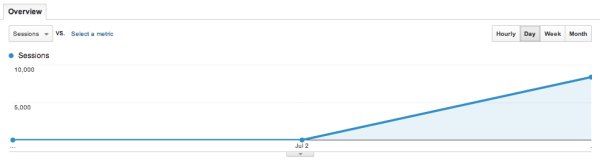
Screen Shot 2014-07-03 at 5.50.59 PM

I guess you can say that any press is good press.

But let’s talk about the questions/criticisms everyone has. What was I thinking! How dare I sell something that’s free! Is this even legal? Is it ethical? Restaurants are going to hate this!

To be honest, I haven’t spent a lot of time thinking through these questions. I built this site as an experiment in consumer demand for a particular product, and the jury’s still out on whether it will work. But I can tell you what I have thought through.

The initial criticism has been about the fact that restaurant reservations are free, and I shouldn’t be selling them. First off, reservations aren’t free. Restaurant tables are limited, in high demand and people wait a good long time as walk-ins to get them. Reservations take time and planning to make and the restaurant assumes an opportunity cost from booking them. My friend joked that it took me less time to build this site than most people spend hunting for OpenTable reservations in a given year.

What about ethics? We are talking about an asset that most people don’t think about having a value. That doesn’t necessarily mean that it doesn’t have a value, or that people wouldn’t be willing to pay for it. For instance, no one would have thought that taking a cab during rush hour should cost more than a normal ride, until Uber launched surge pricing and we realized that people are willing to pay for it. Clearly, the service of booking a reservation in advance has value to patrons. This is evidenced by the startups doing this right now in New York City.

If someone does pay for it willingly, is it really unethical? The consumer has made a choice, the reservation stands, the restaurant gets a table filled as planned, and I have made money for providing the service. That seems perfectly ethical to me. I am aware that the ethical conundrum is around the “what if” question: If I book a table and no one buys it, the restaurant loses business, doesn’t it? I don’t know if that’s true yet, and I’m also working at a volume so low that it probably won’t matter.  I’m canceling the reservations 4 hours before if they don’t get bought, and certainly a restaurant that’s booked weeks in advance won’t have trouble filling a table with their high walk-in traffic, or someone who gets lucky and snaps up the reservation for free on OpenTable.

But more importantly, I think that a paid reservation lets customers get skin in the game, and that means that restaurants might even reduce no-shows if paid reservations become a thing. When Alinea introduced ticketing (pre-paid reservations), they dropped their rate of no-shows by 75%. That’s a pretty good deal in an industry with razor-thin margins.  I’m just speculating on whether this might provide value for restaurants; I can’t speak for them and need to parse this out over the next couple days.

So, back to becoming the most hated person in SF. I learned a lot today about how media, culture and technology in this city interact, and I have to say that overall, I think that the people who have sent me violent threats via email and Twitter, while excessive, may have a point. So in the interest of ethics and fairness, I want to talk to restaurants about working with them directly on a better reservation system. I’ve heard that OpenTable is loathed by many restaurants who don’t want to pay to fill tables. There may be a ticketing solution to high-demand restaurants. If you’re a restaurant, please drop me a line.

And if you’re a regular Jane or Joe, and you missed an opportunity to get a reservation at a hot SF restaurant for your first wedding anniversary this weekend, check to see if there are any reservations available for you at ReservationHop.com.

UPDATE: We have made a “soft pivot” to address feedback from the restaurant and tech industries. Read more here.

132 responses to “How I Became the Most Hated Person in San Francisco, for a Day”

  1. Simpler summary of the response to your idiocy: fuck you, asshole. Watch the “free market” deep six your career and weep, creep.

    Like

  2. John Deaconer Avatar
    John Deaconer

    What would be the problem with restaurant employees beating you about the head and face with a cast-iron skillet?

    I’ll have to think carefully about the impact of that.

    Like

  3. I’m really not seeing a problem with this. Good on you for your entrepreneurial spirit. People are willing to trade money so they don’t have to spend time and hassle getting a reservation themselves. Sounds good to me.

    Like

  4. LOVE it Brian! You go for it….ignore the naysayers and if you can get me a resi for the French Laundry I’m buying!

    Like

    1. Jim – I was going to comment on the lack of ethics you share with Brian…then I took a look at your website. My god – if you can make money & run a business on that 80’s pile of crap site, pitching yourself as an SCO expert – more power to you. That must be the ugliest pile of crap on the internet today.

      Like

  5. Interesting App. What happens when the restaurants start asking for credit card info before reserving a table?

    Like

  6. If you spent half as much time thinking about the ethics of this as you did designing your logo, you’d have abandoned the project from the start. You’re incredibly tone deaf and oblivious to so many issues. Read the comments above and take them to heart. This is stealing. It doesn’t pass the “sniff test.” And it betrays how an arrogant techie can be so blind to so many things.

    Grow up.

    And post a mea culpa here to salvage your currently trashed reputation.

    Like

  7. Brian is not stealing. What he is taking is being given out for free. Does that mean there is no ethical issue? Of course not. One time at my alma mater a group of students decided to take all the campus newspapers because they didn’t like an ad in it. The paper was free but they almost certainly acted wrongly.

    But this is not what Brian is doing. What he is doing is akin to is taking a few free newspapers out of a limited supply and reselling them online to people who weren’t willing or able to go retrieve one.

    It’s actually even a little better than that, ethically since tonight’s meal is probably not much different than tomorrow’s meal – whereas today’s free newspaper will never be published again.

    One can assume that the publishers of a free newspaper want it to be read (not thrown away) and that those who give out free reservations want to fill their tables. Whether Brian’s scheme adds value depends on whether it helps fulfill that goal.

    If anything he is making a scarce resource (a table at a specific date) available for someone who really values it (like that person who forgot about their anniversary…) For those who don’t much care what night they go, it’s a shame to be clogging up a table for the guy who wants to propose on a whim or who forgot an upcoming anniversary. The person who is indifferent can always go later or earlier.

    Where there is an issue is the reservation under a fake name, but that was something that Brian planned to phase out now that he knows there is something people are willing to pay for here. As long as he doesn’t hide who he is, there’s very little to complain about.

    It will take a while for everyone to figure out whether there’s value in this business model or not – but I really have no sympathy for the knee jerk reaction “oh, stuff was free and now it’s priced. Woe is me. The little guy loses again.” Which little guy? The waiter who gets fewer tips because of the jerk who threw away his free reservation and didn’t show up? The struggling restaurant entrepreneur who has to throw away more food every night because reservations were not kept? Or the fishmonger/baker/butcher who would sell more product if only the restaurant owner could be sure people would keep their damn appointments?

    Free reservations, as Brian points out, can lead to waste. Waste is bad – especially for the little guy. Who captures the profit should not detract anyone from the realization that maybe Brian has figured out a way to avoid waste.

    If you’re a Kantian and you think lying is always wrong, then yes Brian used the restaurant as mere means to an end. End of story. However, if you consider that his idea might waste fewer tables and might be profitable for the restaurant owners – then his proof of concept acts in their best interests provided he then reveals to them what his plans are. The ends can sometimes justify the means.

    So I would say that it is not yet clear whether Brian acted unethically – whether he acted unethically in the past depends on what he will do in the future. We should consider the venture as a whole, not merely each part of it. Will he come clean and start a mutually profitable business venture or will he continue to deceive restauranteurs for low stakes?

    Like

    1. Handicapped people pay extra to park in choice parking spaces. What’s the difference?

      Like

      1. David P. Graf Avatar
        David P. Graf

        The difference is between having the money to blow on a reservation and having a serious medical condition.

        Like

    2. I use false names when I make reservations. I don’t think this is fraudulent, since the restaurants themselves are not necessarily interested in your identity. They don’t care who you are, as long as you show up. It is simply not part of the understood contract.

      Right on about the newspapers though. Good analogy.

      Like

  8. We couldn’t get a reservation via Open Table for a hot restaurant in London. The concierge got us a table and we tipped him. Isn’t this the same thing basically?

    Like

  9. I think one of the things that’s sparking vitriol here is that while you’re correct, its not free (a reservation is an opportunity cost to the restaurant) — it’s a resource that is free TO YOU (asserting that your side of making reservations is a negligible cost), which you are then selling.

    Like

  10. I was thinking about this the other day before I found out about Reservation Hopper. Needless to say came across your website from a highly negative by someone that I follow on Twitter although generally, even though they live in SF, they are quiet anti ‘tech bro (male/female) shithead’ and this seems to have gone through that filter. I was thinking about, what happens if I go to SF on a trip for a week and I want to reserve a table at a popular, well-known restaurant. I’m not usually the type to reserve weeks in advance, I am more of a last minute person. I think that this service would be useful BUT only if the restaurant is popular, well-known, ie the Michelin style restaurants. The downside is that as soon as those restaurants catch a whiff of this service, they would probably make a move to block reservations that have been changed for this service if they can find a way of finding out. I can see a service if the place is -really- exclusive, for example I used to be a member of a club paying thousands of dollars per year and only members can reserve at this restaurant. I could sell my ability to reserve, since I am a member, to anyone asking for it. I would really only find use of this if we are looking at those types of high end restaurants where I would be keen enough to actually pay for a reservation from a site like this.

    Like

    1. NB: By the way, I -wouldn’t- actually sell my ability to reserve seeing as I imagine that would be against membership rules? I don’t know, as the thought hasn’t really occurred to me.

      Anyway good on you for actually going out there and giving this a go which is better than most people out there

      Like

  11. Yup, you’re an asshole alright. You’re violating the implicit contract when making a reservation that you already have a party that will take that table. You’re selling something that the restaurant owns – ie their table space. This is not right and not good for society/the-economy at large.

    This is exactly the problem with ISPs fighting net neutrality. They’re trying to sell other people’s data, when ISPs don’t actually own any of that data. Its fucked up, and should be illegal.

    So go fuck yourself. And also, try taking a picture of yourself that doesn’t make you look exactly as trashy as you sound in writing.

    Like

  12. Don’t apologise to these trolls for performing a valuable intermediary service. If they can’t understand that decreasing the uncertainty surrounding obtaining a reservation actually transfers information and thus power from the restaurant to the potential patrons (and might be worth money to some patrons), then let them continue to stew in their normative ignorance about what constitutes productive behavior in society.

    Like

    1. David P. Graf Avatar
      David P. Graf

      Another comment from the “morally clueless” crowd who still doesn’t get that lying is wrong.

      Like

  13. You say

    “The initial criticism has been about the fact that restaurant reservations are free, and I shouldn’t be selling them. First off, reservations aren’t free. Restaurant tables are limited, in high demand and people wait a good long time as walk-ins to get them. Reservations take time and planning to make and the restaurant assumes an opportunity cost from booking them.”

    And I answer: You are a well done capitalist. Because the only thing one has to spend to get a table is time – first come, first serve. Your business-modell changes this to: I jave no time, but money, I will buy it. What next? Will you try to sell fresh air while smog? If one has money, he can breath free?

    Like

  14. “If someone does pay for it willingly, is it really unethical? ”

    Absolutely not. As long as the two parties who enter into the contract do so in an entirely voluntary way, and the contract does not violate the property rights or freedom of a third party, then the contract is valid and the transaction ethical.

    The issue some of the anti-market zealots ahve with services like this is that they do not understand the concept of Opportunity Cost. They will show the same sort of outrage at businesses such as ticket scalping because they do not understand that TIME lost waiting in line IS a cost; that spaces in a venue or a table in a restaurant is a SCARCE GOOD subject to the Law of Supply and Demand just like any other scarce good and that services such as yours actually HELP by providing clear MARKET SIGNALS to market actors about the scarcity of those goods. Those of us who do not want to wait and are willing to pay the extra few dollars to hold a table at the time of our choosing will certainly find the service VERY VALUABLE. Certainly, a table at a high-end restaurant is NOT free. The TIME a person has to WAIT for a reservation is NOT free because nobody can travel in time.

    Like

    1. David P. Graf Avatar
      David P. Graf

      Isn’t scalping reservations a violation of the freedom of others who want to go to the same restaurant? They would want to make a reservation but can’t because this joker has scarfed them all up.

      Like

    2. “The issue some of the anti-market zealots ahve [sic] with services like this is that they do not understand the concept of Opportunity Cost.”

      I think maybe you do not understand the concept of negative externalities.

      Like

  15. The only possible problem I see seems to arise from an assuming multiple names. I don’t think a false name itself is fraudulent in the context of a reservation any more than an internet message board. However, using multiple names, though not necessarily infringing on someone’s property rights, may fall outside current social norms (even on message boards, those who change their profiles are less trusted, etc.) The concern on the part of the restaurant owner, in the context of a reservation, is that the table is filled. What they want to hedge against is a no-show. Your service seems like it would help with that, as those who value the table most highly end up with the claim to the table, with the added advantage of selecting from a vastly greater pool than the small number that can fit in the front lobby waiting area. The only reason people think reservations are ‘free’ is because restaurants give them out pro bono. Convincing restaurants that their reservations are worth paying for may be your first step towards altering the social norm. The way I see it, you may even be able to charge the restaurants for your service, should the service be profitable enough to them. There may be a great advantage to having a demonized third party handle this service for them until public understanding shifts (like Jews circumventing usury laws in the Middle Ages). Eventually, when the climate of opinion shifts, they may offer this service themselves (simply adding reservation purchases to their website).

    Those who lose out on the formerly pro bono goodies might feel slighted, but they have not had their rights infringed on. What they are really arguing for is protectionism for their currently optimal market share.

    This conversation reminds me of Ralph Raico’s discussion on the ‘Dutch Experiment’ (http://mises.org/media/1263/The-European-Miracle : start at 50:50) “Jean-Jacque Rousseau…hated the Dutch, and said that if you go to Amsterdam, and ask somebody the time, he’ll try to charge you for it.”

    I commend you on attempt to discover what people value and get it to them. Well done.

    Like

  16. This service might help restaurants in 2 ways:

    Limiting empty tables
    Perhaps steering higher spenders into seats.

    These reservations aren’t necessarily “free”; but restaurants dont sell them because it would be bad for business overall. But this might create a form of price discrimination for big spenders which helps restaurants and potentially other customers.

    For example, business class flyers subsidize economy flyers. This is potentially a way to identify “business class flyers” for restaurants…

    Like

  17. Brian,

    You are a true capitalist. Keep it up! Don’t let the envy of lazy folks deter you. I’d happily use your service to get a reservation tonight at a restaurant that typically has a 6 month wait. You are making people’s lives better. Let the trolls be trolls!

    Like

    1. David P. Graf Avatar
      David P. Graf

      If the restaurant has a six month wait, then there are no reservations to be had anyways! By the way – who’s lazier – the guy who takes the time to set up a dinner six months in advance or someone who tries to score a meal the same day?

      Like

  18. Dear Brian, Consistent with your strategy, I have used a fake name too! I read your justification for what u call value and a business. If it is so well justified and there is real value in what you do, why are you using fake names to make bogus reservations? You are a cheat and so is your business. I am all for entrepreneurs and creating value, but you put shame on the profession if you call yourself and your new idea entrepreneurial. Best of luck as you go down with your business…..

    Like

  19. I view this as identical to ticket scalpers with screen scraping technology to snap up all concert tickets within 2 minutes of release time. If there’s a concert you really want to see, it’s no contest. You have to pay their inflated prices. “Free market” my ass..

    Like

  20. Some thoughts


    And it seems that everywhere you look cherished public resources are being claimed by startups, whether it’s Google laying claim to bus stops or parking apps laying claim to, well parking spaces. I’d half expect someone to come along one day and put picnic blankets down in Dolores park and sell them at $25 apiece.

    Do you realize that what you’re doing is exactly like selling parking spaces or spots at Dolores? This might not have been the best choice of analogy.


    And as someone who spends a lot of time complaining to my friends about how much of an insular bubble San Francisco has become, what with apps built by the 0.1% for the 0.1%, I completely agree.

    So why contribute to that midset? Why make an app that makes life easier for people with money at everyone else’s expense instead of making something beneficial to eveyone?


    Meanwhile, traffic has gone through the roof. Here’s my actual Google Analytics graph from today.

    PR tip, this makes you sound like a douche. I’m not aying you’re a douche, I’m saying this line is really bad form in the context of this post.


    To be honest, I haven’t spent a lot of time thinking through these questions

    Why not? It’s your job as an entrepeneur to think about these things.


    For instance, no one would have thought that taking a cab during rush hour should cost more than a normal ride, until Uber launched surge pricing and we realized that people are willing to pay for it. Clearly, the service of booking a reservation in advance has value to patrons. This is evidenced by the startups doing this right now in New York City.

    First, new york medalian cabs have always charged more at rush hour. What you’re talking about is peak demand pricing, it’s a whole different thing. What you’re doing is scalping.


    What about ethics? We are talking about an asset that most people don’t think about having a value. That doesn’t necessarily mean that it doesn’t have a value, or that people wouldn’t be willing to pay for it.

    You have totally missed the point. Just because an asset has value, or even is undervalued, doesn’t mean that increasing it’s price is beneficial or ethical. Again, take scalping– Here’s an item (a ticket) that clearly has value, and in fact is undervalued if demand outstrips supply. So a scalper scoops it up and re-sells it at whatever the market demands. Is that ethical or legal? Depends on your ethics and the law. Is it shitty? Absolutely. You’ve added no value to either the producer (the artist) or the consumer (the concertgoer). You’ve simply turned scarcity into profit. It’s parasitic, plain and simple. Innovation, disprution, whatever you want to call it, is about using technology change business models for the better. It’s not about applying a business model we all hate (scalping) to new sectors.


    But more importantly, I think that a paid reservation lets customers get skin in the game, and that means that restaurants might even reduce no-shows if paid reservations become a thing.

    Actaully no. If restaurants want to reduce no-shows, they can charge deposits, they don’t need you to fix that problem for them. You’re increasing no-shows because your unsold inventory becomes thier no-show. Plus, if your user decides to forfiet their $12 and no-show, you keep your money, but the restaurant still loses. You’re not going to form any kind of symbiotic relationship with the restaurant industry here.

    Like

  21. The problem is shitheads like you in tech. You have just confirmed the bubble. Everyone in sf is fucked the end is near. You guys need to wake up and get a clue. Most of this bullshit being created is not tech and has absolutely no value to the general public. The early 2000’s being played again. Just watch the pin is over your head about ready to hit the bubble.

    Like

  22. Ugh, please go away. You’re a parasitic worm.

    Like

  23. Your self-delusion that you’re some kind of innovator and not just an incredibly self-centered asshole is what has elevated this to viral status. Don’t delude yourself that anything about this is due to your “service”; it’s just emblematic of the many ways sociopathic dicks ruin society for the rest of us.

    Like

  24. It does sound like ticket scalping but if Mayer could somehow come up with something that benefits all the parties (customers, restaurants, the public) I could say why not give it a try and see how things turn out. If things turn out to be bad for any of them, it must be stopped, that is all. At least, he is revealing what he is doing online and to the public to some extent, he does not sound like a complete secret dishonest person.

    Like

  25. His sentences seem to indicate that he is a reasonable guy. Some of the negative and ad hominem comments toward him sound unfair.

    Like

Leave a reply to Shel Cancel reply